

Nov 11th 2026
Off the Floor, Into Sight: High-Impact Interior Wayfinding with Ceiling Brackets

Off the Floor, Into Sight: High-Impact Interior Wayfinding with Ceiling Brackets
In a busy commercial interior, the challenge isn’t always creating more signage. It’s putting the right information where people can actually see it.
Retail stores, food halls, indoor markets, hotels, entertainment venues, and other high-traffic spaces have to communicate a lot at once. Customers need to locate departments, identify vendors, find restrooms, navigate corridors, and make their way toward checkout or service areas—all while moving through a space filled with displays, fixtures, merchandise, furniture, and other people.
When wall and floor space are already working overtime, look up.
Overhead signage turns unused ceiling space into a highly visible wayfinding zone. With ceiling-mounted brackets, suspended sign systems, and strategically placed wall-mounted signs, businesses can improve navigation without adding another obstacle at floor level.
Why Interior Wayfinding is Above the Crowd
Good wayfinding should answer a visitor’s next question before they have to stop and ask it.
Where do I check out? Which way is the café? Where are the restrooms? Which aisle has what I need?
In crowded interiors, signs placed at eye level can quickly disappear behind shelving, product displays, partitions, or other customers. Overhead signage establishes a higher sightline, helping directional and identification signs remain visible from farther across a space.
This is especially useful in environments with multiple destinations under one roof, including:
-
Indoor markets and food halls
-
Retail stores and showrooms
-
Hotels and hospitality spaces
-
Restaurants and cafés
-
Shopping centers
-
Event and entertainment venues
-
Office and mixed-use environments
Instead of competing for valuable floor space, overhead signs use an area that might otherwise serve no navigational purpose.
Ceiling-Mounted Arch Brackets: Wayfinding That Becomes Part of the Space
Functional signage doesn’t have to look purely functional.
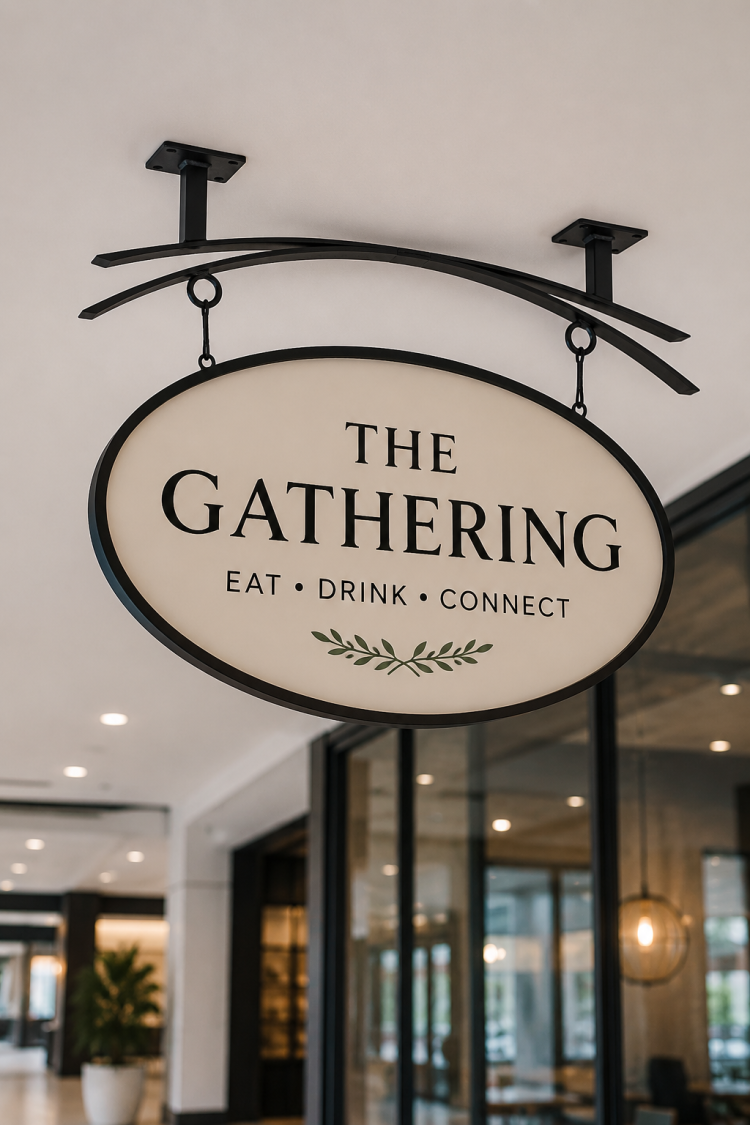
A ceiling-mounted arch bracket can turn a directional or identification sign into an architectural feature, giving businesses a way to incorporate wayfinding without making the interior feel cluttered with utilitarian hardware.
The Haiku Arch Ceiling Mount Sign Bracket, for example, is designed for mounting to a flat ceiling and works particularly well with oval or circular signs. Its solid steel construction, black powder-coated finish, and curved profile give it a finished appearance suited to commercial interiors where the hardware will remain visible. Available in 30", 40", and 50" lengths, it also provides options for different sign sizes and spatial conditions.
That makes this type of bracket a natural fit for signs identifying individual stores in a mall, departments within a store, service areas in a hotel, or destinations along a commercial corridor.
Rather than hiding the mounting system, the bracket becomes part of the overall visual language of the space.
Suspended Signs Add Flexibility
Not every overhead sign requires a substantial architectural bracket.
Suspended chain systems provide another straightforward way to bring signage down from the ceiling and into the customer’s line of sight. Sign hangers can connect compatible sign substrates to chain, S-hooks, or quick-attach links, creating a simple suspended display.
This approach can work particularly well for aisle markers, directional signs, department identifiers, menu boards, or other information that needs to be clearly visible without occupying a wall or floor area.
Suspension height matters. The objective is to bring the sign low enough to be easily seen while maintaining the clearances required for the specific space. Sign size, weight, substrate, attachment points, ceiling construction, and mounting hardware should all be considered when planning the installation.

Don't Forget the Walls: French Cleats for Clean Interior Signage
Overhead mounting solves one type of wayfinding challenge, but an effective interior sign program often uses multiple mounting methods.
For larger wall-mounted signs, directories, branded panels, and architectural displays, Heavy Duty French Cleats provide a strong, low-profile mounting solution while keeping the hardware hidden from view.
Sign Bracket Store's Heavy Duty French Cleats are made from aluminum alloy and sold in pairs, with one cleat attaching to the mounting surface and the other to the back of the sign or display. Once the two pieces engage, they create a secure mounting system that distributes the load across the cleat while allowing the display to sit close to the wall.
Available in lengths from 2.5 inches to 8 feet, they offer a versatile solution for a range of commercial interior signage applications.

Plan the Hardware Alongside the Sign
A successful interior sign installation starts before the finished sign arrives.
Consider the sign's dimensions, thickness, substrate, weight, mounting location, attachment points, and required clearances when selecting hardware. Ceiling construction and mounting surfaces also need to be evaluated so appropriate fasteners and installation methods can be selected for the project.
And don't overlook aesthetics. A bracket, chain, cleat, or sign hanger may seem like a small component, but visible hardware can influence how polished the completed installation feels.
Treating signage and hardware as one system helps create a more intentional result—one that supports navigation while complementing the design of the space.
Explore ceiling mount sign brackets, sign hangers, French cleats, and other sign mounting hardware from Sign Bracket Store to find the right solution for your next interior signage project.